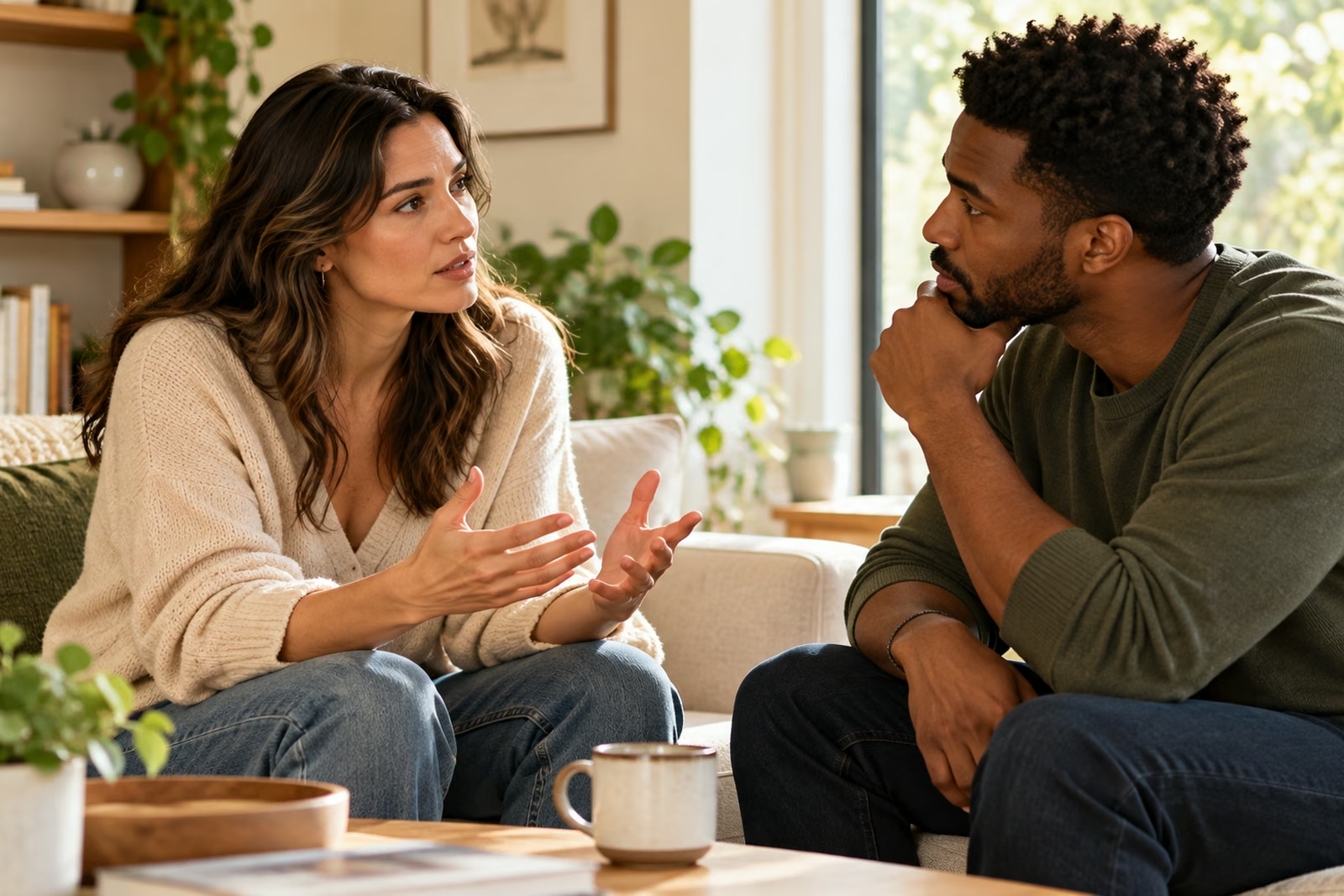
You meet someone.
The conversations are good. They make you laugh. You look forward to hearing from them. Before long, you find yourself checking your phone, thinking about them at work, and planning things you never thought about before.
You feel alive.
You tell your friends you have finally found someone special.
And then come the words we hear so often:
"I have so much love to give."
There is nothing wrong with feeling this way. Falling in love is one of life's most personal experiences. It brings joy, hope, and a sense of closeness.
But I want to ask you something.
What if the strongest part of what you feel is not about the person you have met?
What if some of it comes from how much better you feel about your own life now they are in it?
That is a question worth asking.
Not because your feelings are false. Not because you are wrong to want love.
But because there is a difference between choosing someone you love and needing someone to make your life feel worth living.
And sometimes, we confuse the two.
Love Is Not the Problem. What We Expect From It Might Be.
Let's get something straight.
Happy people fall in love too.
They feel attraction. They get nervous before dates. They miss people. They enjoy romance, sex, affection, and everything else a loving relationship brings.
Being happy does not mean you stop wanting human closeness.
But there is one difference worth looking at.
A person who enjoys their life has something they already value.
They have interests, friends, plans, and things they enjoy doing. Their life is not perfect, but they are not waiting for someone to arrive before they begin living it.
When they meet someone special, they have a choice.
They might think, "I enjoy my life, and I would love to share part of it with you."
Now think about someone who feels lonely, lost, or unhappy with life.
They meet the same wonderful person.
But their thoughts might sound different.
"Finally, someone who makes me happy."
"Now I have something to look forward to."
"I don't know what I would do if I lost this person."
Both people might feel love.
The difference is what they are asking love to do for them.
One wants to share a life.
The other might be hoping someone will save them from a life they do not enjoy.
Neither person deserves shame. We all go through hard times.
The point is to understand what is driving our choices.
The Harder You Fall, the More You Should Understand Why
Have you ever met someone who fell deeply in love within days?
They talk for hours. They share their secrets. They send good morning and good night messages. They begin planning holidays, moving in together, and sometimes even marriage.
Everything happens quickly.
And when someone asks whether they are moving too fast, they answer:
"When you know, you know."
Sometimes, strong feelings grow into lasting love.
But feelings alone do not tell you how well you know someone.
You might know what makes them laugh without knowing how they handle anger.
You might know what they want in a partner without knowing how they treat people when things go wrong.
You might know their dreams without knowing how they deal with money, stress, or responsibility.
And yet, you feel sure.
Why?
Because sometimes we fall in love with what we hope a person will bring into our lives before we know who they are.
We fill in the missing parts with what we want to believe.
A lonely person might see companionship.
A person who feels unwanted might see acceptance.
Someone who feels stuck might see a new beginning.
The other person begins to stand for everything we have been missing.
This does not mean the attraction is fake.
It means the feeling might be doing more than helping us get to know someone.
It might also be helping us forget something painful.
And the faster our feelings grow, the more important it becomes to ask whether we are learning about the person or building a dream around them.
Strong feelings deserve attention, but they are not proof of deep love.
"I Have So Much Love to Give." But What About You?
This is one of the most common things people say when they want a relationship.
"I have so much love to give."
"I would treat someone so well."
"I would do anything for the right person."
"I just want someone to appreciate me."
These are often sincere words.
There are people who care deeply, give freely, and want to build a good relationship.
But I want us to look at those words from another angle.
You say you have so much love to give.
How much of it do you give yourself?
Do you treat yourself with the same kindness you want to show a partner?
Do you make time for things you enjoy?
Do you respect your own needs?
Do you keep the promises you make to yourself?
Do you speak kindly to yourself when you make mistakes?
Or do you save all your care, patience, and attention for someone you hope will enter your life?
Think about a person who says:
"I would do anything to make my partner happy."
Yet they never take time to do anything for themselves.
They will listen to someone's problems for hours but refuse to ask for help with their own.
They will encourage a partner to follow their dreams while giving up on their own.
They will forgive someone else's mistakes but spend years punishing themselves for theirs.
This person has love to offer.
But there is an important question.
Why does someone else need to receive the kindness they struggle to give themselves?
Sometimes, giving becomes a way to feel needed.
We hope someone will return our care, choose us, praise us, and make us feel important.
Giving is good.
But giving in the hope of finally feeling worthy of love places a heavy burden on the relationship.
You are worthy of care before another person chooses you.
And you deserve some of the love you are so ready to give away.
When Someone Becomes Your Main Source of Happiness
Picture two people who have started dating.
They enjoy talking every evening.
One night, a message goes unanswered for three hours.
The first person notices but carries on with their evening. They know the other person has a life too.
The second person becomes upset.
They check their phone again and again.
They wonder if they said something wrong.
They begin to fear the person is losing interest.
When the message finally arrives, they feel happy again.
Look at what happened.
The other person's attention began to control how they felt about themselves.
This is not always a sign of a serious problem. Most of us have felt unsure about someone we care about.
But when this keeps happening, it is worth understanding.
If someone's attention makes you feel valuable, their silence might leave you feeling worthless.
If their affection makes life feel good, a disagreement might make life feel unbearable.
If they are your only source of comfort, the thought of losing them might feel frightening.
Now the relationship has a new job.
It must keep you feeling okay.
And this is where love starts to feel heavy.
The other person has their own feelings, needs, worries, and responsibilities. They will have tired days. They will sometimes need space. They will sometimes disagree with you.
They are human.
They will not always be available to give you the feeling you want.
A healthy relationship allows room for two people to have their own lives while caring for each other.
It does not require one person to keep the other happy every hour of the day.
Happy People Still Need Love and Support
I want to be careful here.
There is a popular saying:
"You must be happy alone before you can be happy with someone."
There is some wisdom in it.
But it is not the whole story.
People need connection.
We need friendship, care, understanding, and support.
A person might be happy with their work and hobbies but still want someone to hold at night.
Someone might enjoy being single and still want a family.
Another person might be going through grief or a difficult time and find genuine love along the way.
None of this means they are using someone.
And nobody needs to become perfectly happy before entering a relationship.
Research also gives us a more balanced picture.
A study of more than 3,000 single adults found that people who were more satisfied with life were slightly more likely to enter a relationship over the following six months.
So happiness does not appear to stop people from finding love.
Other research has linked choosing a relationship for your own honest reasons with greater relationship satisfaction.
This matters because a good relationship is not about two people who never need help.
It is about two people who choose each other and are willing to support each other.
You should be able to lean on someone you love.
You should be able to say, "I need you today."
You should be able to ask for comfort when life gets difficult.
The difference is whether your partner supports your well-being or becomes responsible for your entire sense of worth.
Those are two different things.
Are You in Love With the Person or the Life You Hope They Will Give You?
Sometimes, what attracts us is what we think our life will become.
You meet someone who lives in a place you have always wanted to visit.
You begin thinking about a new home, a new country, and a new future.
You meet someone who seems confident and successful.
You start seeing yourself beside them, living a different life.
Or you meet someone who gives you the attention you have been missing.
For the first time in years, you feel wanted.
These feelings are understandable.
But here is a useful question:
If this person had nothing new to offer your life except who they are, would you still choose them?
Take away the promise of a better home.
Take away the money.
Take away the status.
Take away the thrill of being wanted.
Take away the hope of starting over.
Would you still enjoy talking to them?
Would you respect how they think?
Would you enjoy an ordinary Tuesday with them?
Would you still want to know them when the first rush of attraction has settled?
Because eventually, a relationship has ordinary days.
There are bills, work, tired evenings, family problems, and moments when neither person feels romantic.
You will not always agree.
You will not always feel excited.
And the person you love will sometimes disappoint you.
If you chose them because they made your problems disappear for a while, those problems might return.
But if you chose them because you know them, respect them, enjoy them, and want to build something together, you have more to work with when life becomes difficult.
The Difference Between Choosing Someone and Trying to Keep Someone
One of the clearest ways to understand your feelings is to notice what happens when you do not get what you want.
Suppose you meet someone you care about.
You want the relationship to grow.
But they tell you they need more time.
A person who feels secure might be disappointed.
They might feel sad or frustrated. They might decide waiting is not right for them.
But they still understand that the other person has a choice.
Someone who needs the relationship to feel okay might struggle more.
They might begin trying harder.
More gifts.
More messages.
More promises.
More attempts to prove how much love they have to offer.
They might start giving more than they are comfortable giving because they fear losing the relationship.
And sometimes, they give so much they begin to lose sight of their own needs.
This is not a reason to judge them.
It is a reason to ask what they are afraid of losing.
Are they afraid of losing a person they have come to know and love?
Or are they afraid of returning to how life felt before the person arrived?
Both forms of pain are real.
But understanding the difference helps us make better choices.
Love needs room for both people to choose.
Giving more does not make another person owe you a relationship.
And being deeply disappointed does not mean you should give up your self-respect.
Not Everyone Is Ready for a Relationship Right Now
There is one more truth we should talk about.
Not everyone wants a relationship. And not everyone is ready for one right now.
That is okay.
Think about someone who hurts their leg. They may love playing football, but going back before they are ready might make the injury worse. They need care, rest, and time to build strength.
A hurt heart is harder to see.
You may have been cheated on. You may have grown up in a home where love felt unsafe. You may have been rejected, lied to, or made to feel small.
The pain does not vanish because someone new treats you well.
And the next person should not have to pay for what someone else did.
For example, you meet a caring partner. They are honest with you. But each time they go out with friends, you fear they will cheat. You demand their passwords, ask them to prove where they are, or accuse them without a clear reason.
Your fear has a story. It deserves care.
But your partner still deserves trust, privacy, and respect.
A painful past explains why something feels hard. It does not make hurtful behaviour fair.
Or perhaps you pull away whenever someone gets close. You want love, but you keep ending things before you feel safe. It might help to spend time learning why you react this way.
This is where being single for a while might be a good choice.
You might speak with a counsellor, find support from people you trust, learn how to set boundaries, or rebuild parts of your life you have put aside. You do not need to rush because friends say it is time to meet someone.
But let me be clear.
A person who has been hurt is not unworthy of love. Having a difficult childhood or a painful past does not mean you must stay single. People often heal in safe, caring relationships, too.
You do not have to be fully healed before you date.
What matters is whether you are willing to face your pain without making someone else responsible for fixing all of it.
Are you able to say, "I struggle with trust because I have been hurt, and I am working on it," rather than, "You must give up your freedom so I never feel afraid"?
Are you willing to listen when your partner tells you your actions hurt them?
Can you admit when you need help?
Those questions matter more than any fixed waiting period. There is no rule saying you need six months or a year before you love again.
And remember, this applies to everyone.
You can care about someone and still choose not to begin a relationship with them. You can wish someone well without taking on the job of healing them. Being kind does not mean accepting control, blame, or poor treatment.
Sometimes the best decision is to slow down and work on yourself before asking another person to build a life with you.
That is not giving up on love.
It is making a choice with care.
Your Life Should Still Belong to You
Think about what happens to your normal life when you begin dating someone.
Do you still spend time with friends?
Do you continue doing things you enjoy?
Do you keep working toward your goals?
Do you feel free to disagree?
Do you make choices because they feel right to you, or because you fear upsetting the other person?
New relationships need time and attention. Your routine will change, and there is nothing wrong with making space for someone.
But there is a difference between making space and giving up everything else.
A relationship should offer both people room to grow.
You should feel free to be yourself.
You should be able to keep your values.
And you should not have to abandon your plans to prove your love.
The same applies to your partner.
If you love someone, their happiness outside the relationship should matter too.
They have a life, interests, goals, and friendships of their own.
Their independence is not always a threat to your closeness.
Sometimes, it helps keep the relationship healthy.
A Simple Check Before You Give Your Heart Away
If you are dating someone, falling in love, or thinking about returning to an old relationship, take a few minutes to answer these questions.
Be fair to yourself. There are no scores and no perfect answers.
1. Am I happy with at least some parts of my life without this person? If not, what needs my attention? 2. What do I love about this person beyond the way they make me feel? 3. Am I getting to know who they are today, or thinking mainly about the future I hope we will have? 4. Have I stopped doing important things for myself since meeting them? 5. Do I feel free to say no, ask questions, and move at my own pace? 6. Am I dealing with old hurts in a fair way, or asking a new partner to carry them for me? 7. If this relationship did not work out, would I still have a life I wanted to care for and improve?
You do not need to answer yes to everything.
These questions are here to help you see where you stand.
Perhaps you have been neglecting yourself.
Perhaps you have allowed a new relationship to take up too much space.
Perhaps you are doing well, and you have met someone who brings genuine joy into your life.
Whatever you find, be honest.
You do not have to punish yourself for having emotional needs.
You simply need to understand them.
Start Giving Yourself Some of What You Are Seeking
If you often say you have a lot of love to give, try something for the next seven days.
Choose one thing you normally hope a partner will do for you.
Perhaps you want someone to encourage you.
Encourage yourself by taking one step toward a goal you have delayed.
Perhaps you want someone to spend time with you.
Set aside time for something you enjoy, or reach out to a friend.
Perhaps you want someone to tell you that you matter.
Look at what you have achieved, the people you have helped, and the values you live by.
Perhaps you want someone to listen.
Give yourself time to write down how you feel, without judging yourself for it.
And if you need support, ask someone you trust.
Taking care of yourself does not mean doing everything alone.
The aim is to stop placing all your hope in one future partner.
As you begin meeting more of your own needs, you might notice a change.
You might become less willing to accept poor treatment because you are afraid of being single.
You might find it easier to let someone move at their own pace.
You might become more interested in who a person is than in how quickly they promise to love you.
Most importantly, you begin to see a relationship as something you choose rather than something you need to prove your worth.
A Final Thought: Love Should Be a Choice, Not a Rescue Plan
I do not believe happy people are unable to fall in love.
I believe happiness gives us a different place from which to choose.
You still feel attraction.
You still want affection.
You still experience longing, desire, and the joy of being close to someone.
You might fall deeply and quickly. You might take months to develop feelings.
Neither speed tells the whole story.
The question is whether you are choosing the person or hoping they will give you a life you do not yet have.
And there is no shame in admitting that you want things to improve.
Perhaps you are lonely.
Perhaps your last relationship hurt you.
Perhaps you have spent years caring for other people and want someone to care for you.
Those feelings matter.
But before asking another person to give you all the love you have been missing, look at how you are treating yourself.
Give yourself time.
Give yourself kindness.
Take your own dreams seriously.
Build friendships.
Work on the parts of your life you have been putting off.
And when someone comes along who you genuinely want to know, enjoy, and love, make room for them.
You do not have to pretend you need nothing.
You do not have to close your heart to protect your independence.
You only need to understand why you are opening it.
Because there is something worth thinking about when you say:
"I have so much love to give."
My question is simple.
How much of that love are you willing to give yourself?
And once you begin answering that question, you might find yourself choosing relationships for a different reason.
Not because you are waiting for someone to make you worth loving.
But because you have met someone worth sharing your life with.
---
### Research and further reading
- MacDonald, G., et al. (2026). "Why Do You Want a Romantic Relationship? Individual Differences in Motives for Romantic Relationship Pursuit." Personality and Social Psychology Bulletin. https://doi.org/10.1177/01461672251331699
- Qin, H. Y., et al. (2026). "In What Domains Does Entering a Romantic Relationship Boost Well-Being? A Longitudinal Investigation." Social Psychological and Personality Science. https://doi.org/10.1177/19485506251371351
- Körner, R., et al. (2024). "Is Caring for Oneself Relevant to Happy Relationship Functioning?" Personal Relationships. https://doi.org/10.1111/pere.12535